WORKSHOP · MEMORY ARCHITECTURE · WS·08

The Resolution Layer — Why Your AI Gets Confused

How to turn meetings, email, and documents into a memory you can trust — by sorting out who and what before the AI says anything. The one step everyone skips, and the gate that makes the rest of the AI stack defensible. 20 slides, 30 minutes.

20 SLIDES · ~30 MIN · PLAYBOOK OVERVIEW
Key Takeaways
  • Before an AI can answer questions about your company, it has to know who and what you are talking about. Get that wrong, and every answer sounds confident — and can't be trusted.
  • Which pile of documents do I already feed to AI? Name the one workflow where you most rely on AI summaries today. That's the pile worth resolving first.
  • How to turn meetings, email, and documents into a memory you can trust — by sorting out who and what before the AI says anything. The one step everyone skips, and the gate that makes the rest of the AI stack defensible. 20 slides, 30 minutes.
WORKSHOP · MEMORY ARCHITECTURE

The Resolution Layer

Why your AI gets confused.

BuildClub Academy
01 · THE ONE IDEA

Sort out
who and what
first.

Before any answer, summary, or roadmap.
This is the step everyone skips —
and the step that decides whether
your AI can be trusted.

The Thesis
02 · WHERE THIS FITS

Every company already has a brain. The trick is trusting it.

1
The records
Your meetings, email, chat, CRM notes, tickets, documents, contracts. The raw material is already there — you do not need a new corpus. You need a way to read the one you have.
2
The memory
How an AI stores and connects all of that so it can answer questions. This is where vendors compete loudly. It is also where the resolution layer either exists or quietly does not.
3
The front door
Who can ask, what they see, and what gets cited back to them. The user interface — important, but downstream of the question this workshop is actually about.

Today is about the step in the middle that almost everyone skips — the one that decides whether answers can be trusted.

02 · WHY IT'S YOUR PROBLEM TOO

You don't need a big AI project to hit this. You need a second document.

Your inbox
'Summarize my email.' Two people named Chris get merged into one — or one Chris gets split into two depending on the thread. The summary reads fine. It is wrong.
A folder of transcripts
A decision from last week reads as if it's still current. 'He said the deal is off' — but who is he, and is it the same he as the next mention? The AI does not flag the ambiguity.
A stack of contracts
'The vendor' means three different companies across three agreements. Obligations land on the wrong one. The error survives review because the AI's summary sounds clean.
One client's meetings
Action items pile up with no clear owner. Nothing connects from one call to the next. The AI does not remember what was decided two weeks ago — because it never resolved who decided it.

These are not edge cases. They are the default behavior of every naive pipeline that skips resolution.

03 · WHY IT GOES WRONG

What most people build — and why it degrades in production.
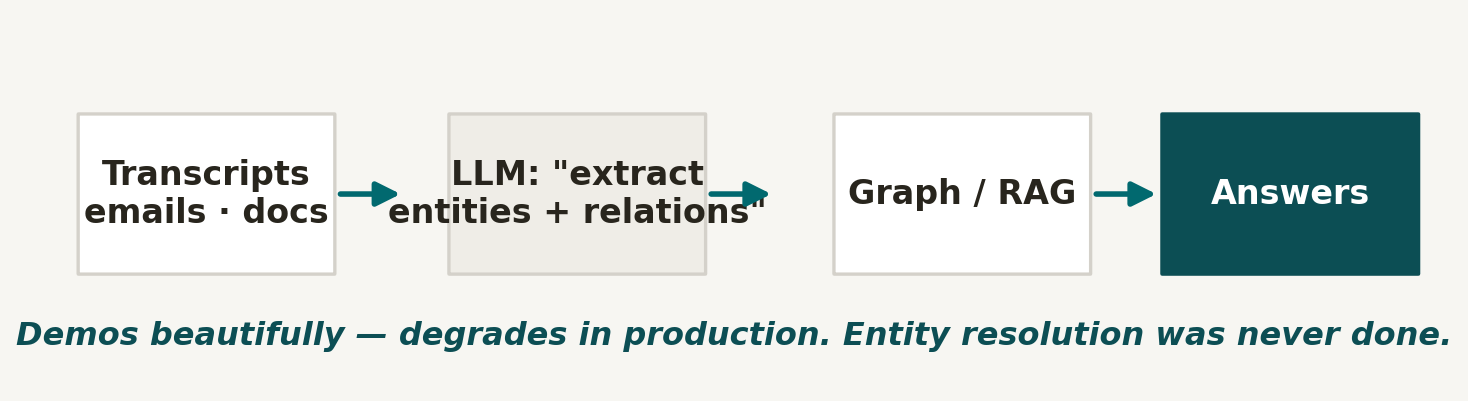
What most people build — and why it degrades in production.
Transcripts · emails · docs → LLM extracts entities + relations → graph or RAG → answers. Looks elegant. Demos beautifully. Degrades in production.

Entity resolution was never done. The pipeline never asked whether two names refer to the same thing. The bug is silent and structural.

03 · WHY IT GOES WRONG

Five ways an AI gets confused.

1
2
3
4
5
1
Same person, many names
'Stephen,' 'Steve,' and 'the CEO' become three different people in the AI's head. The resulting org chart is wrong before any decision is made on top of it.
2
Lost track of 'he'
'He said the client wasn't ready' — but who is he, and which client? Pronoun resolution fails across paragraphs, then across documents, then across weeks.
3
Invented connections
The AI claims a link the conversation never actually made. The model fills the gap between two sentences with a plausible relationship that was never there.
4
No two answers agree
Ask the same thing twice, get it sorted differently each time. The output looks confident both times. Neither answer is reproducible.
5
Old news stays current
A decision that was reversed in April still shows up as the latest word. Without time-aware resolution, the system treats every fact as eternal.

A smarter AI fails the same way, faster. The fix is to sort out who and what first.

04 · THE FIX, IN ONE PICTURE

How a meeting becomes a memory you can trust.
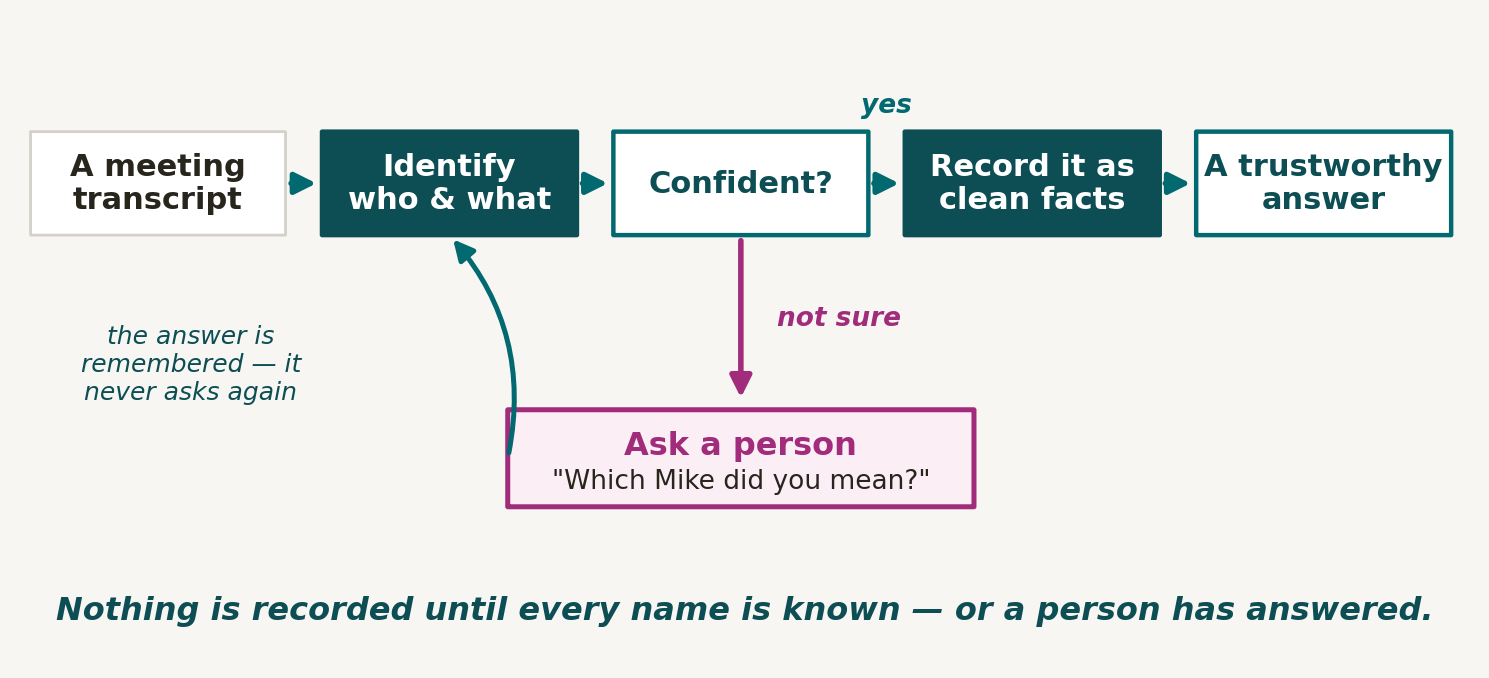
How a meeting becomes a memory you can trust.
Transcript → identify who & what → confident? → either record as clean facts → trustworthy answer, or ask a human first. Nothing is recorded until every name is known.

Nothing is recorded until every name is known — or a person has answered. The middle branch is the part everyone skips.

04 · THE FIX

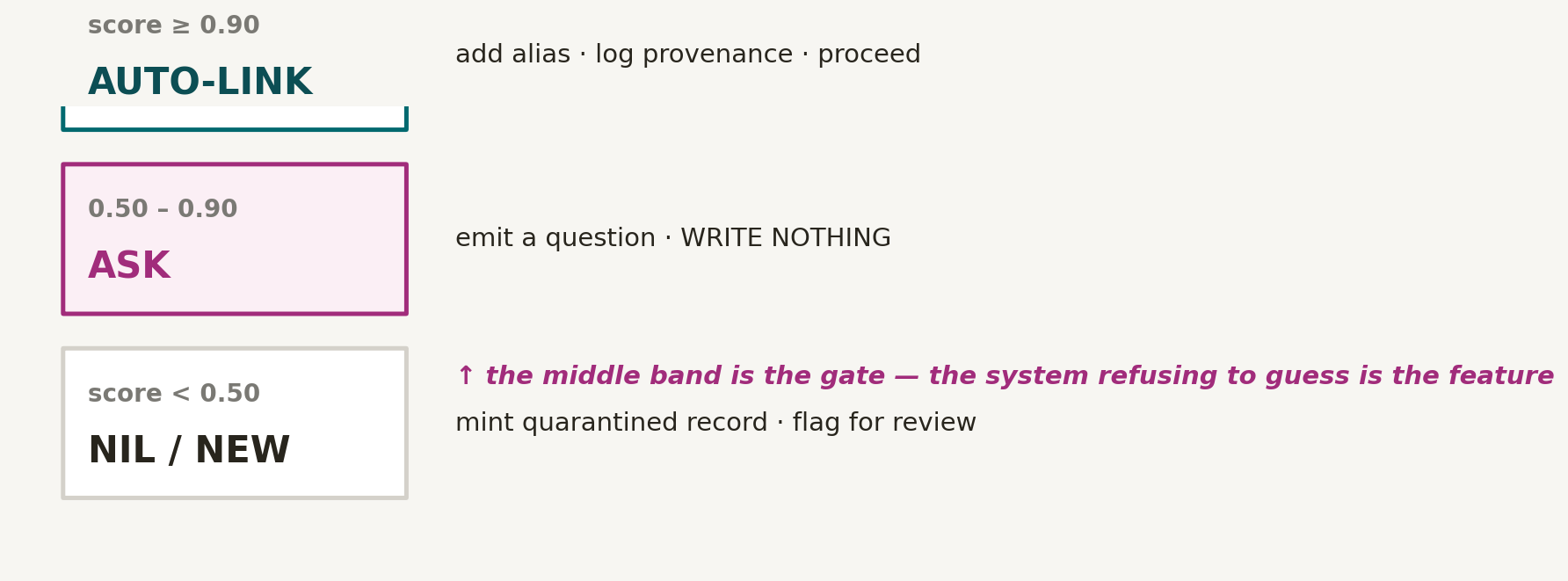
When unsure, ask — don't guess.

When unsure, ask — don't guess.
Three bands. Score ≥ 0.90 = AUTO-LINK. 0.50–0.90 = ASK (write nothing). Score < 0.50 = NIL / NEW (quarantined record, flag for review). The middle band is the gate.

A system that admits 'I'm not sure' and asks you is worth far more than one that confidently guesses wrong. The middle band is the feature.

05 · A USEFUL PICTURE

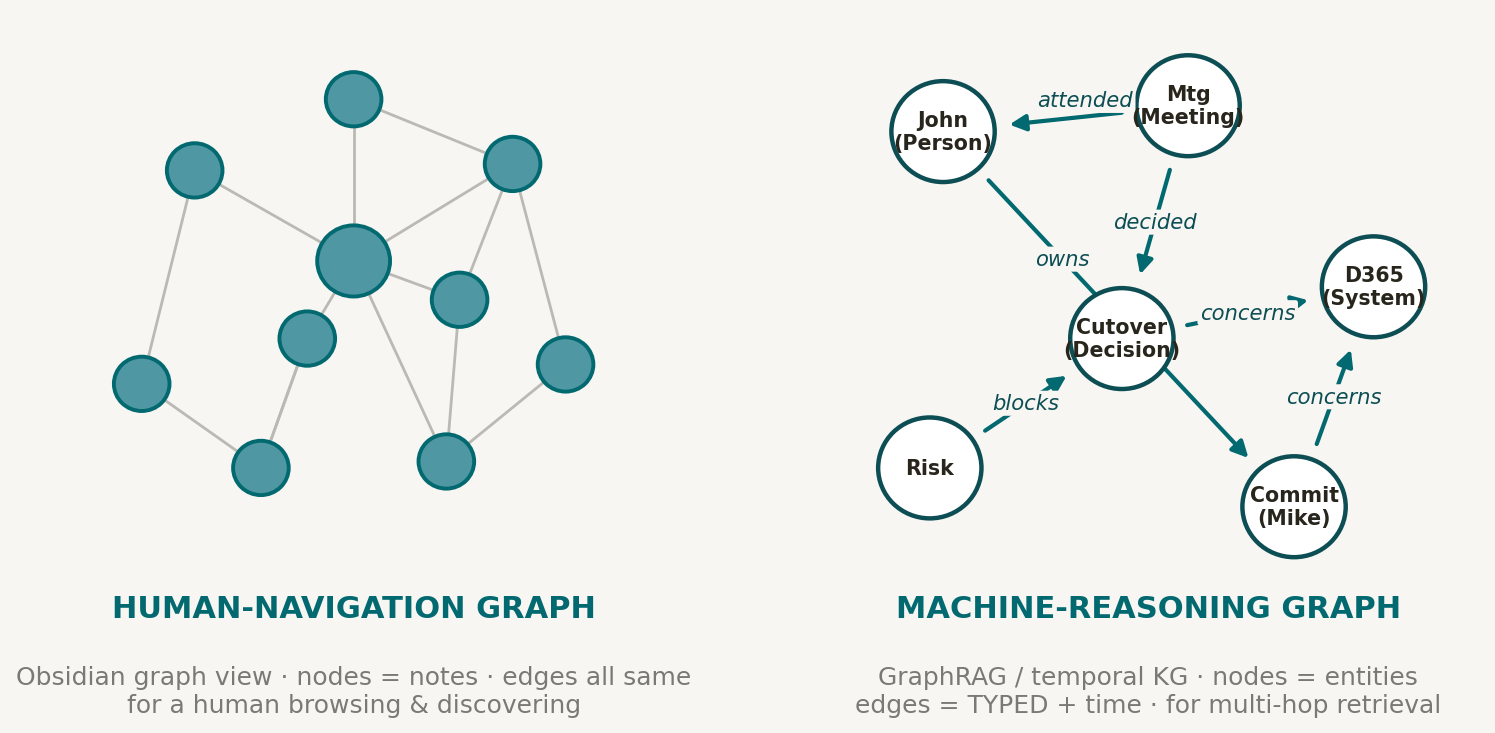
Two maps of the same company.

Two maps of the same company.
Left — Obsidian-style human-navigation graph (untyped nodes, undirected edges, for browsing). Right — GraphRAG / temporal KG (typed entities, typed edges, time-stamped, for multi-hop machine retrieval). Both built from the same resolution layer.

One map is for people to browse. The other is for the machine to reason over. You want both — built from the same source.

05 · A SAFETY HABIT

Never rewrite the original — add the answer alongside it.
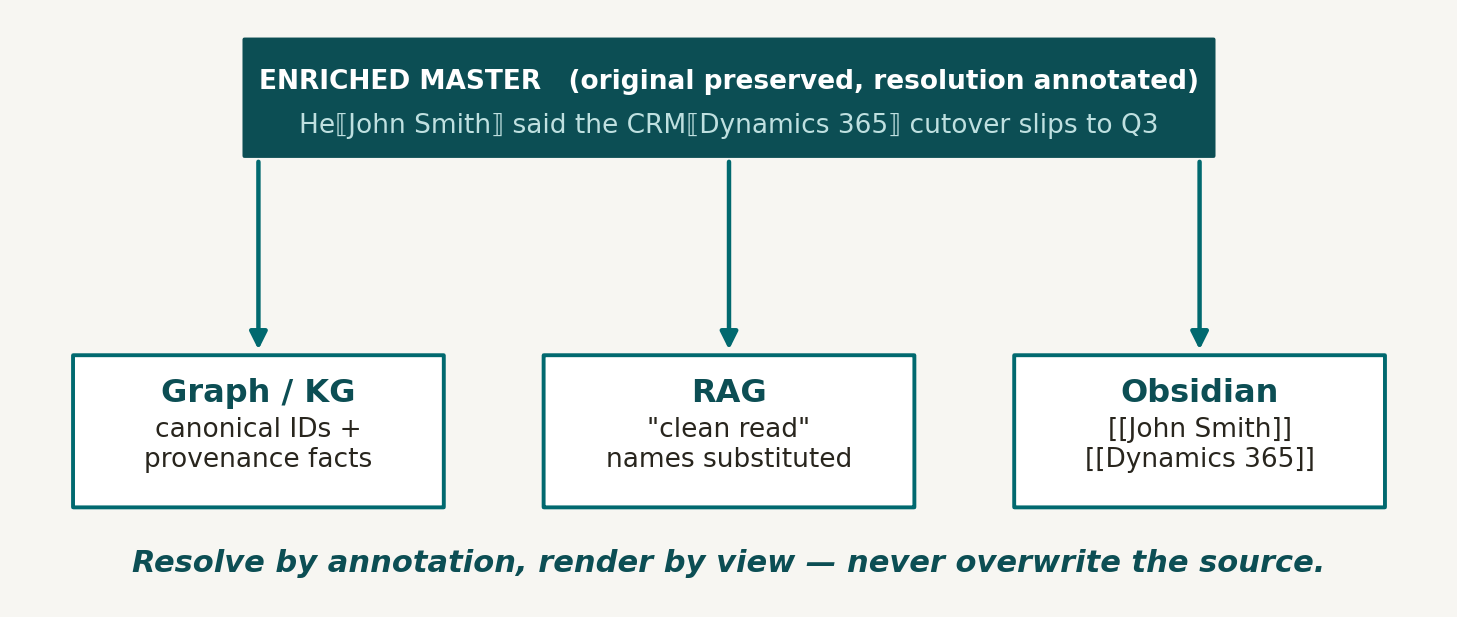
Never rewrite the original — add the answer alongside it.
One enriched master at the top — original sentence with resolutions annotated inline. Three views derived from it: Graph / KG (canonical IDs + provenance), RAG (clean read with names substituted), Obsidian (wiki-links for humans).

Resolve by annotation, render by view — never overwrite the source. One master, three renderings, zero loss of provenance.

05 · KEEPING IT HONEST

A spell-checker for your company's memory.

Broken links
A fact points to a person or system that was never recorded. Caught automatically — every reference must resolve to a real registry entry, or the fact is held in quarantine until it does.
Contradictions
Two 'current' decisions disagree on the same question. The system flags the conflict; a human reviewer picks the canonical version and supersedes the other. Disagreements never silently coexist.
Made-up claims
A statement the original conversation never actually supports. AI-as-judge flags it for review by checking whether the claim traces to a verbatim sentence in the source. No traceback, no claim.
Stale facts
Old information that should have expired but is still treated as true. Time-aware resolution downweights facts past their validity window; the spell-checker flags any answer that depends on them.

When the checker finds a problem, it routes it to a person — and the fix makes the whole memory smarter. Like a software team catching bugs before shipping.

06 · IN PRACTICE

Where it lives — and why it's reviewable.

1
The clean facts — small, reviewed, versioned
The list of people, systems, and decisions. Every entry is reviewed; every change is logged. Like tracked changes in a document — a CFO or auditor can see what changed, when, and who approved it. Smaller than you think.
2
The transcripts — large, stored as-is
The raw recordings, emails, and notes. Numerous and big, kept exactly as they came in. The source of truth is preserved, untouched. Resolution annotates; it never overwrites.
3
The waiting list — questions pending humans
One place that shows everything currently waiting on a human answer. Nothing quietly slips through. A reviewer works the queue; the system never advances on its own when the answer is unclear.

Three stores, three jobs. Small clean registry, big raw corpus, visible question queue.

07 · MONDAY MORNING

What to do Monday — start small.

1
2
3
4
5
1
Pick one pile you already use
One client's meetings, your own inbox, or one contract folder. Not the whole company. The smallest unit of work that is still useful — usually one engagement, not one department.
2
List the names first
Write down the people, systems, and companies in that pile before asking the AI anything. Twenty entries on a single page. This is the seed registry. The system grows from here.
3
Turn on 'ask, don't guess'
Make your AI ask when it's unsure — and never let it rewrite the original. If your current tool cannot do this, you are using the wrong tool. This is the test.
4
Keep a visible waiting list
One place for open questions, so none get lost. A shared document, a Notion page, a single Slack channel — the medium does not matter. The visibility does.
5
Scale only once it works
Add more once the loop runs smoothly on one pile. Resist the urge to onboard a second engagement until the first is producing trustworthy answers for two consecutive weeks.

You don't need a company-wide program. One pile, one habit, one visible list.

07 · REMEMBER

Four things to remember.

1
2
3
4
1
Sort out who and what first
Before any summary, any extraction, any answer. This is the step everyone skips — and the step that decides whether the rest is trustworthy.
2
When unsure, ask — don't guess
A system that asks beats one that confidently guesses wrong. The clarification cost is paid once; the wrong-answer cost is paid forever.
3
Never rewrite the original
Keep the source so any answer can be traced back and checked. Resolution is additive — annotations on top of the source, never a replacement for it.
4
Start small, then scale
One pile of documents, one habit, one visible list. Prove it before you expand. The companies that win at AI memory are the ones that crawled, then walked.

Four habits. Each one is small enough to start tomorrow.

CLOSING

Five questions to take home.

Monday Morning
  1. 1
    Which pile of documents do I already feed to AI? Name the one workflow where you most rely on AI summaries today. That's the pile worth resolving first.
  2. 2
    When my AI tool is unsure, does it ask me — or quietly pick one? If you don't know, the answer is almost certainly the second one. Find out this week.
  3. 3
    Could I ask 'what did we decide about X, and when?' — and trust the answer? If the answer is no, the resolution layer is missing. The fix is operational, not a vendor purchase.
  4. 4
    Who would own the list of names, and who reviews changes? The clean facts registry needs an owner. Not a committee. Pick the person.
  5. 5
    What's the one pile I could prove this on by Friday? Pick the smallest viable scope. One engagement, one inbox, one folder. Start there.
APPENDIX

Under
the hood.

What 'clean facts' actually look like.
The records the system keeps for
every person, system, and decision —
and the engineering view of the pipeline
that produces them.

The Thesis
APPENDIX · A PERSON RECORD

One official name, many aliases.

one record per real person
id: person--acme--michael-reyes type: Person official_name: "Michael Reyes" other_names: - "Mike" - "Mike R" - "M. Reyes" match_only_names: - "mike reyez" # a typo organization: org--acme-corp role: "VP Sales" status: confirmed
Official name
The one name shown everywhere. Aliases resolve to it but never replace it.
Aliases
Display-safe nicknames + match-only typos. The system is tolerant of bad input without ever propagating it to output.
Role & company
How the system tells two Mikes apart. Two Mikes at the same role at the same company = flagged conflict.
Status
Provisional until a human reviews. Provisional records never feed downstream extraction.

One record per real person. Aliases compound. Role and company disambiguate. Status gates whether downstream pipelines trust it.

APPENDIX · 'THE CRM' PROBLEM

The same words mean different things at different clients.

the product — defined once
id: system--ms-dynamics-365 official_name: "Microsoft Dynamics 365" other_names: - "D365" - "Dynamics" - "MS Dynamics" category: "CRM"
the local meaning — per client
client: acme-corp generic_term: "the CRM" resolves_to: system--ms-dynamics-365 # At Acme, "the CRM" = Dynamics. # At Zenith, "the CRM" = Salesforce.

The product is defined once. A small note per client says what 'the CRM' means in their world. Without this split, every mention of 'the CRM' is globally ambiguous.

APPENDIX · ACTIONS & DECISIONS

Every fact points back to a real person — and a real moment.

an action item — linked to a real owner
id: commit--acme--2026-05-28--001 type: Commitment description: "Deliver revised licensing terms" owner: person--acme--michael-chen concerns: system--ms-dynamics-365 status: open due: 2026-06-15 # Because the owner is a real, identified person — # not the word "Mike" — you can now ask: # "Every open action Michael Chen owns, # across all our meetings."
a decision — with a history
id: decision--acme--2026-05-28--001 statement: "CRM cutover slips to Q3" decided_by: person--acme--john-smith valid_at: 2026-05-28 supersedes: decision--...--003 status: current # Decisions remember when they were true. # You can ask: "What was true in April?" # — not just "what is true today?"

Provenance plus time. The two ingredients that turn 'AI summary' into 'auditable company memory.'

APPENDIX · UNDER THE HOOD

The same workflow, in engineering terms.
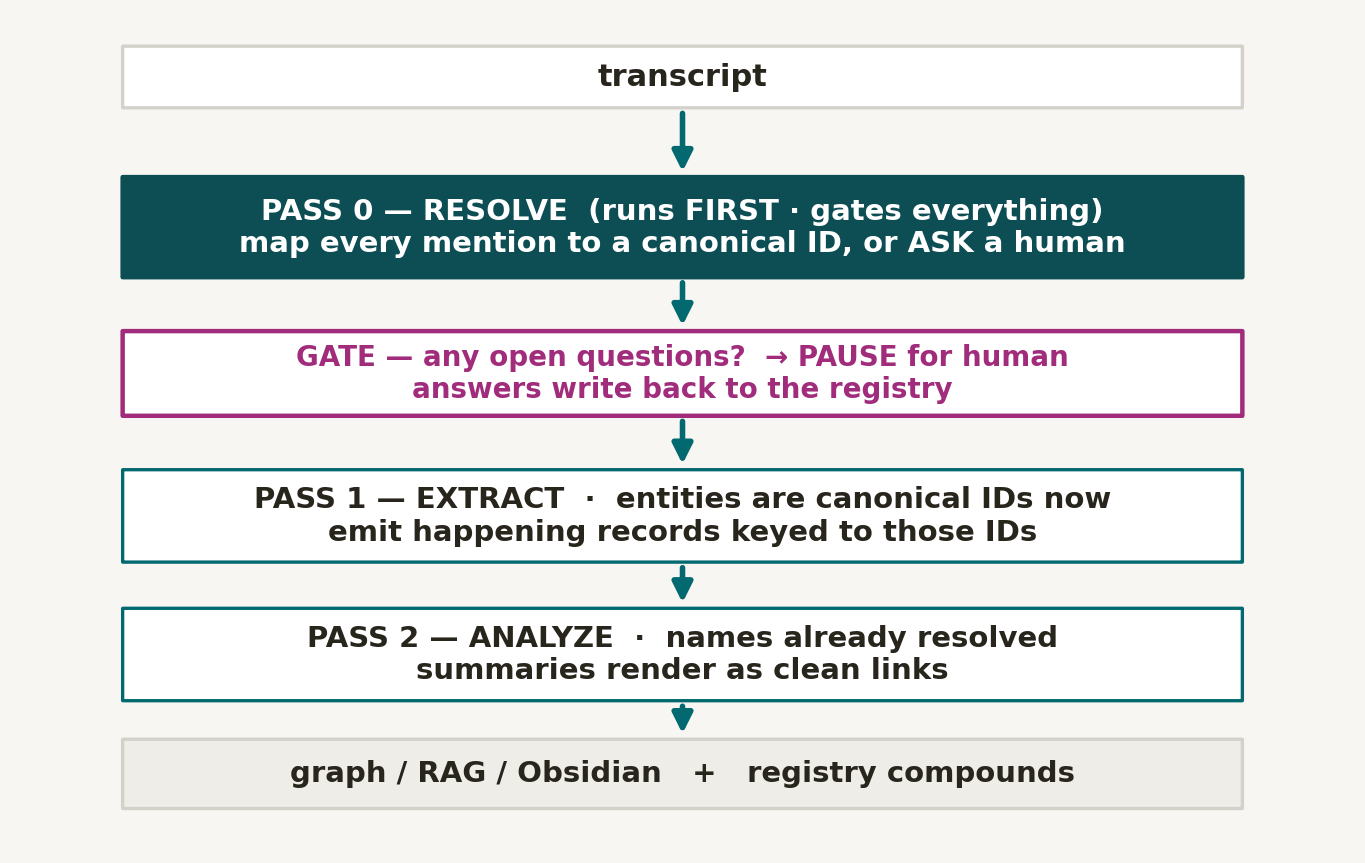
The same workflow, in engineering terms.
Transcript → PASS 0 RESOLVE (runs first, gates everything) → GATE (any open questions? pause for humans) → PASS 1 EXTRACT (entities are canonical IDs now) → PASS 2 ANALYZE (names already resolved) → graph / RAG / Obsidian + registry compounds.

Resolve before extract. Extract before analyze. The order of operations is the entire architecture.

WS·08 · Questions CEOs Ask

Frequently Asked Questions

What is the core idea of The Resolution Layer — Why Your AI Gets Confused?
Before an AI can answer questions about your company, it has to know who and what you are talking about. Get that wrong, and every answer sounds confident — and can't be trusted.
What should a CEO do Monday morning after reading The Resolution Layer — Why Your AI Gets Confused?
Start here: Which pile of documents do I already feed to AI? Name the one workflow where you most rely on AI summaries today. That's the pile worth resolving first; When my AI tool is unsure, does it ask me — or quietly pick one? If you don't know, the answer is almost certainly the second one. Find out this week; Could I ask 'what did we decide about X, and when?' — and trust the answer? If the answer is no, the resolution layer is missing. The fix is operational, not a vendor purchase.
What are the steps in The Resolution Layer — Why Your AI Gets Confused?
1) Same person, many names; 2) Lost track of 'he'; 3) Invented connections; 4) No two answers agree; 5) Old news stays current.
Where do the claims in The Resolution Layer — Why Your AI Gets Confused come from?
The playbook cites Internal workshop source material; Obsidian graph view reference; GraphRAG documentation.
00 / 20